
Kitchen Cabinet Painting vs. Replacement: Which One Actually Saves You More in 2026?
A 2026 cost breakdown of painting, refacing, and replacement, with real labor and material data, lifespan numbers, and the questions to ask before signing any quote.
You stand in your kitchen and decide something has to change. The cabinets look tired. The finish is peeling near the sink. The whole space feels a decade behind the rest of your house.
So you start getting quotes. Two weeks later you're staring at numbers between $3,000 and $25,000 for what feels like the same project.
This is where most homeowners get stuck. The fear isn't the cost itself. It's not knowing whether the contractor is quoting fair work or quietly steering you toward the most expensive option.
The good news is there are really only three paths: painting, refacing, and full replacement. Each one has a clear price range, a clear lifespan, and a clear set of conditions where it's the right call. Here's how to tell which one fits your kitchen, with 2026 data from the industry's published sources.
The honest cost comparison
Below are the 2026 national ranges for a standard kitchen with roughly 20 linear feet of cabinetry. That covers most 10x10 layouts.
Painting. A professional job runs $2,000 to $6,500, or about $30 to $60 per linear foot. Spray application is on the higher end ($40 to $100 per linear foot) but produces a factory-smooth finish. DIY brings materials down to $200 to $600 if you have the time and the skill. Data from HomeGuide, Angi, and AllBetter 2026 cost guides.
Refacing. Expect $4,000 to $9,500 for an average kitchen, or $100 to $250 per linear foot. This sits in the middle because you're paying for new doors, drawer fronts, and veneer on the existing boxes. You skip the full demo. Data from Modernize and AAR Models 2026.
Replacement. Stock or semi-custom cabinets in a standard kitchen run $4,500 to $15,000. Custom cabinets push that to $12,000 to $24,000. Per linear foot: stock $100 to $400, semi-custom $150 to $700, custom $500 to $1,200. Data from HomeGuide, HomeLight, and Marfa NuEra 2026 cost guides.
A quick note on the labor numbers you'll see in quotes. The Bureau of Labor Statistics reports the median painter earns $48,660 a year, about $23 an hour. The median carpenter earns $59,310, about $28.50 an hour. That's May 2024 data, the most recent BLS release.
The $50 to $100 per hour you see on contractor invoices is the billable rate. It includes overhead, insurance, equipment, materials handling, and profit. Both numbers can be accurate at the same time. The point is that when a quote breaks labor into clear hours and rates, you have something concrete to verify. For the full breakdown of how to read those line items, see How to Tell If a Contractor's Estimate Is Too High.
One 2026-specific factor worth knowing about. A 25% tariff on imported kitchen cabinets took effect in October 2025, with a further increase to 50% scheduled (currently delayed until January 2027). Domestic manufacturers haven't dropped prices to compete. They've held margins. The practical result for homeowners: replacement quotes have crept up in 2026, while painting and refacing are unaffected because they reuse the existing boxes.
Want a number for your specific kitchen instead of a national range? Run your project through estimate4u.io for a free line-item breakdown of both painting and replacement scenarios, with labor based on real U.S. wage data and materials based on current US market data.
When painting actually makes sense
Painting is the right answer more often than contractors will tell you. It works when:
- Your cabinet boxes are structurally sound. No water damage, no warping, no mold, no swollen particleboard. The frames need to hold paint, which means they need to hold their shape first.
- The material takes paint well. Solid wood is ideal. Quality MDF works with the right primer. Laminate and thermofoil need specialty primers and a careful hand, but they can work.
- You like your current layout. Painting doesn't move the sink, the dishwasher, or the fridge. If the layout is the real problem, painting won't fix it.
- Your cabinets are less than 20 to 25 years old. Older cabinets often have hidden damage that turns a painting job into a repair job halfway through.
- Your budget caps out around $7,000. Above that, refacing starts to make more sense.
How long does a paint job actually last? Properly prepped and sprayed, a professional job goes 7 to 12 years before it needs a refresh. Some quality jobs last longer. Brush-and-roller jobs typically last 3 to 7 years. DIY work without proper prep can start chipping within 6 to 12 months. Numbers from HomeGuide, AllBetter, and Kitchen Search 2026.
The cheap version is rarely the cheap version over a decade.
When you should bite the bullet and replace
Replacement is the right call when:
- The boxes are failing. Water-damaged, mold, swollen particleboard, doors hanging crooked because the frame is no longer square. Paint on a failing box is money set on fire.
- You want to change the layout. Moving the sink, the range, or the fridge means new plumbing or electrical, and that means new cabinets to match the new configuration.
- Your cabinets are 25+ years old and showing it. Particleboard absorbs moisture over time. Solid wood holds up longer, but hinges, slides, and shelves wear out.
- You're staying in the home long-term. Custom cabinets can last 40 years or more. Semi-custom runs 20 to 30 years. Stock cabinets average 10 to 15 years. If you're staying two decades, the math on replacement starts to work. Lifespan data from TruVine Renovations and AllBetter 2026.
- You hate the door style and the layout has bigger issues. Refacing fixes the door style alone. Replacement fixes everything.
What replacement quotes often hide. Demolition costs $300 to $800. Disposal fees vary by city. Electrical adjustments add $500 to $2,000. Permits run $500 to $2,000 depending on where you live. Ask whether each of these is a separate line in the quote, not folded into "labor."
Don't forget about refacing
Refacing is the option contractors don't always bring up first. It's worth understanding before you sign anything.
Here's what it actually is. The existing cabinet boxes stay on the wall. The doors and drawer fronts come off and get replaced with new ones. The visible parts of the frames get covered with new veneer or laminate to match. Hardware is replaced. The result looks like a new kitchen, but you keep the original boxes, the original plumbing, and a much shorter timeline (3 to 5 days versus 2 to 6 weeks for full replacement).
Refacing is the right choice when your boxes are solid but you hate the door style itself. Painting can change the color of a raised-panel cathedral door, but it's still a raised-panel cathedral door. Refacing swaps it for flat-panel Shaker or whatever you want.
Cost-wise, refacing typically runs 30 to 50% less than a full custom cabinet replacement. Some homeowners save up to 78% on a cabinet refresh project compared to full replacement, according to Modernize 2026.
Why don't contractors push this option harder? Replacement carries higher margins in most cases. Refacing is also a more specialized skill, so general contractors who don't do it in-house won't recommend it. Ask, and you'll usually get a fair answer. If a contractor immediately dismisses refacing without even asking about your cabinet condition, that's a signal worth noting.
What the resale math actually says
If you're considering this work because you're planning to sell, the data is clear.
The 2025 Cost vs. Value Report from Zonda and Remodeling Magazine is the industry's most cited annual benchmark. It found that a minor kitchen remodel returns 112.9% of its cost at resale nationally. That's the single highest ROI of any interior home improvement project, for the second consecutive year. The national average minor remodel cost was $28,458, with $32,141 added to resale value.
The same report found that major midrange remodels return only 50.9%. Upscale major remodels return 35.7%. The more you spend, the less of it you get back at sale.
The "minor kitchen remodel" scope the report uses explicitly includes cabinet refacing or painting, new countertops, and updated appliances, with the layout unchanged.
If you're selling within 1 to 3 years, the smart move is almost always to refresh, not to replace.
3 questions to ask before signing any quote
Whichever path you take, three questions will tell you a lot about the contractor.
"How are you pricing this, per linear foot, per door, or flat?" All three are valid pricing methods. But the contractor should be able to explain clearly what's included in their chosen one. A vague answer is a warning.
"What paint or finish are you using, and what's the warranty?" Cabinet-grade enamels (Benjamin Moore Advance, Sherwin-Williams Emerald, ML Campbell) are the industry standard. Wall paint on cabinets chips within months. A real warranty runs 2 to 5 years.
"What's included in prep work?" Prep is 30 to 50% of a painting job. If the contractor glosses over it, the finish will fail. You want to hear about degreasing, sanding, primer, repairs, and masking.
For a more complete checklist of red flags in any contractor estimate, the first article in this series covers it in detail: How to Tell If a Contractor's Estimate Is Too High.
Get your own number before the next quote
National ranges are useful for orientation. They don't tell you what your specific kitchen should cost.
The difference between a fair $4,500 paint job and an inflated $7,500 paint job is the line-item detail. The only way to know which one you're looking at is to have your own breakdown to compare against.
Run your project through estimate4u.io for a free, structured estimate with labor based on real U.S. wage data and materials based on current US market data. You get materials and labor broken out by category. And it turns the next contractor conversation from a one-way pitch into a real negotiation.
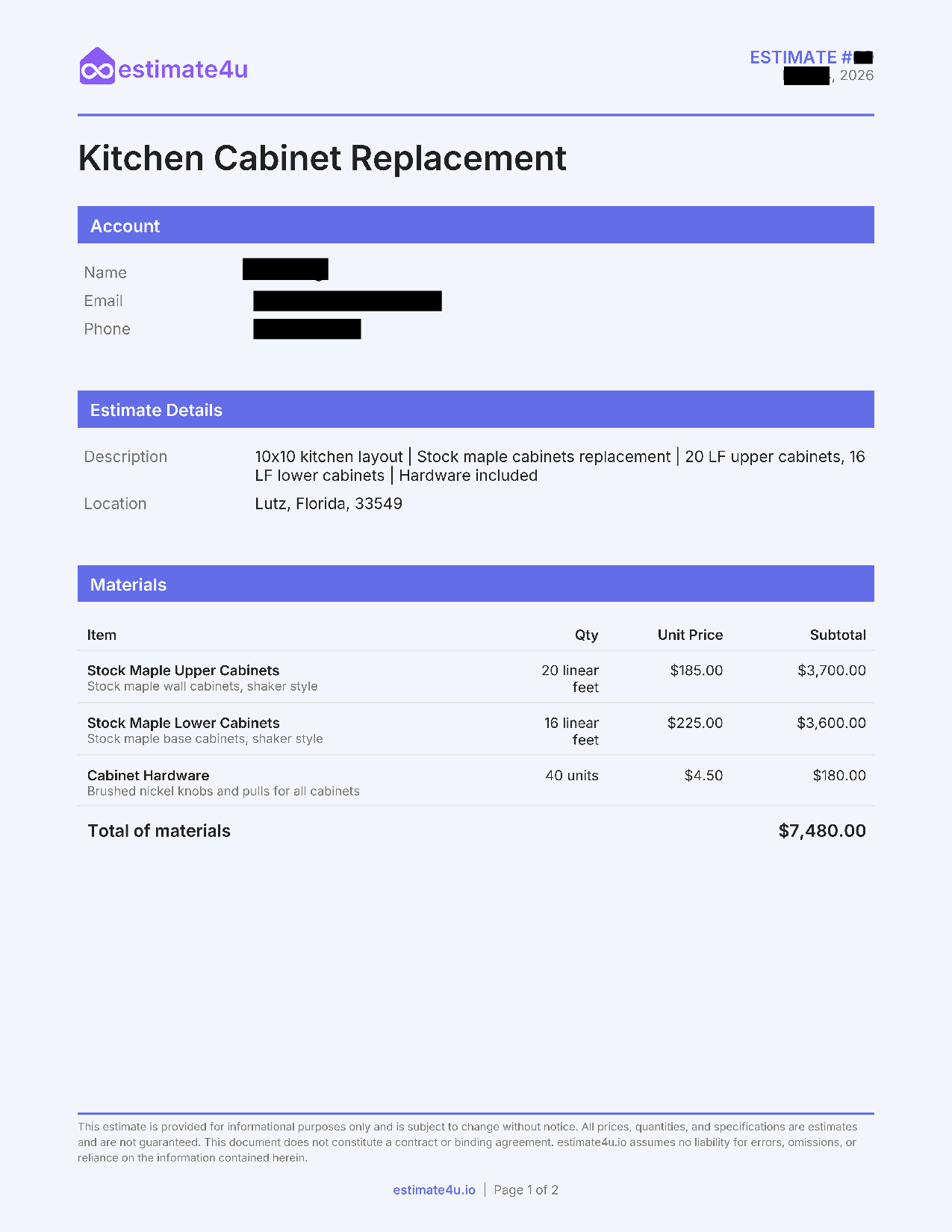
Here's what a real estimate from estimate4u.io looks like for a 10x10 kitchen cabinet replacement:
Sources
Cost ranges in this article are based on 2026 published data from:
- HomeGuide, Cost to Paint Kitchen Cabinets
- HomeGuide, Kitchen Cabinets Cost
- Angi, How Much Does It Cost to Paint Kitchen Cabinets
- HomeLight, Cost of Kitchen Cabinets Installed
- Modernize, Cabinet Refacing Cost
- Bureau of Labor Statistics, Painters and Carpenters, May 2024 data
- Zonda 2025 Cost vs. Value Report
- 2025-2026 tariff schedules for imported kitchen cabinets and vanities
Want your own line-by-line estimate?
Describe your project in plain words and see the cost of materials and labor for your ZIP code. Free, no sign-up.
Get my free estimate