
How Much Does a Generator Sub-Panel Cost? A Real $3,200 Florida Install (2026)
A real backup generator sub-panel install in Lutz, FL. Full line-item estimate, install photos, interlock vs transfer switch explained, and the key questions to ask any electrician before signing.
Hurricane Milton hit Florida on October 9, 2024 as a Category 3. By the next morning, 3.4 million people were without power. In Pasco County, where our founder Jia lives, a lot of homes didn't get power back until October 14.
Jia's house is on well water and septic. No electricity meant no well pump. No well pump meant no water for showers, dishes, or even flushing the toilet. The septic pump alarm came on within hours. The fridge and freezer started warming up.
For two and a half days the family ran a portable generator on the driveway, with extension cords running through a side door to whichever appliance needed power most.
A few months later, Jia installed a 125-amp sub-panel with a generator inlet at the outside of the garage. He did the work himself with a friend and pulled the county permit as the homeowner. If you hired a licensed electrician for the same project, the line-item estimate from estimate4u.io comes to $3,200.
Below is the full breakdown. Photos from the install, the actual estimate, and the one technical choice (interlock instead of a transfer switch) that saves most homeowners between $400 and $1,200.
Why a sub-panel beats running cords from the generator
A few extension cords can power a fridge and a window fan. They can't power anything wired into the house. The well pump, the septic pump, the central AC, the electric water heater, the bathroom outlets, the ceiling fans. None of those have a plug.
A sub-panel fixes that. The new panel is wired into the circuits you care about. When the generator is running, those circuits work the same way they normally do. Wall switches still work the lights. The well pump kicks on by itself. The septic pump cycles when it needs to.
The other reason to install a sub-panel: it's the only legal way to do it.
Plugging a generator into a regular wall outlet (called backfeeding, often done with a homemade "suicide cord") pushes power backward through your panel and out onto the street. The CPSC has warned for years that this can electrocute the lineworkers trying to restore power. It also bypasses your circuit breakers. An overload doesn't trip anything, it just starts a fire.
The National Electrical Code section 702.6 is direct: any equipment connecting a generator to a house must prevent the generator and the grid from being on at the same time. Two pieces of hardware do this job. A transfer switch, or an interlock kit. Both pass inspection. One costs a lot less.
Interlock kit vs transfer switch: the $400 to $1,200 question
This is the single decision that moves the bill the most. Most homeowners go with whatever the electrician suggests first, and bigger jobs tend to default to a transfer switch. For a portable generator running essentials, that's usually overkill.
| Interlock kit | Manual transfer switch | Automatic transfer switch | |
|---|---|---|---|
| Hardware | $50 to $150 | $300 to $800 | $1,000 to $2,500 |
| Install | A few hours | Most of a day | A day or more |
| Best for | Portable generators, essentials only | When the main panel can't fit an interlock | Whole-house standby generators |
An interlock kit is a sliding metal plate on your electrical panel that makes it physically impossible to have both grid power and generator power on at the exact same time. A manual transfer switch is a small second panel with a lever you flip between grid power and generator. An automatic transfer switch senses the outage and switches by itself, and is usually paired with a permanent standby generator. All three are code-compliant under NEC 702.6.
For just less than $100, Jia bought a Square D interlock kit that mounts directly onto his sub-panel cover. Switching to generator power takes two steps: slide the metal plate up, which forces the main breaker off, then flip the 50-amp generator breaker. It is a purely mechanical, foolproof system with no electronics to fail during a storm.
What goes on a generator sub-panel
The 125-amp sub-panel sits about four feet from the main panel in the garage. It has ten breaker slots. The circuits feeding it are the ones the family actually needs when the power is out:
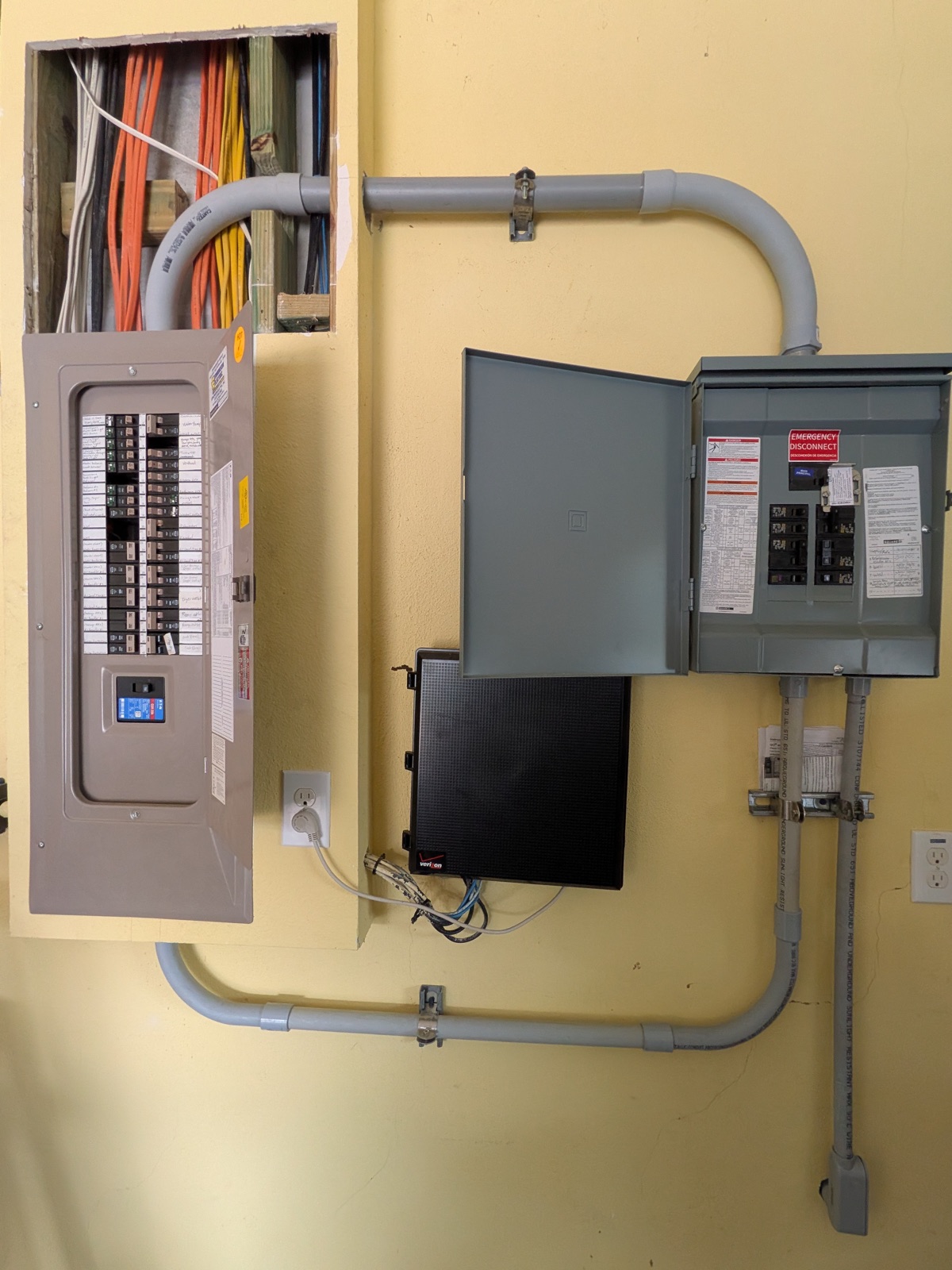
- Well pump. No well pump, no water in the house.
- Septic pump. A septic system with a pump will alarm within hours of losing power. An overflowing tank is a much worse problem than no electricity.
- Electric water heater (garage). Cold showers in October aren't really an option.
- Refrigerator and the kitchen GFCI outlet. A full fridge holds for about 4 hours unopened. After that, food starts spoiling.
What's not on the sub-panel: central AC, the electric dryer, the dishwasher, and the electric range. A 10,500-watt portable generator can run a few more circuits, but it can't run the AC at the same time as the well pump and the water heater. So you pick. Essentials only, until the utility comes back.
A simple way to plan this for your own house: write down everything you can't live without for three days. Add 25 percent on top. That's the size of generator and sub-panel you want. Anything bigger is money you'll never use.
The install in photos
Here is the work in progress, before the new sub-panel cover went on:
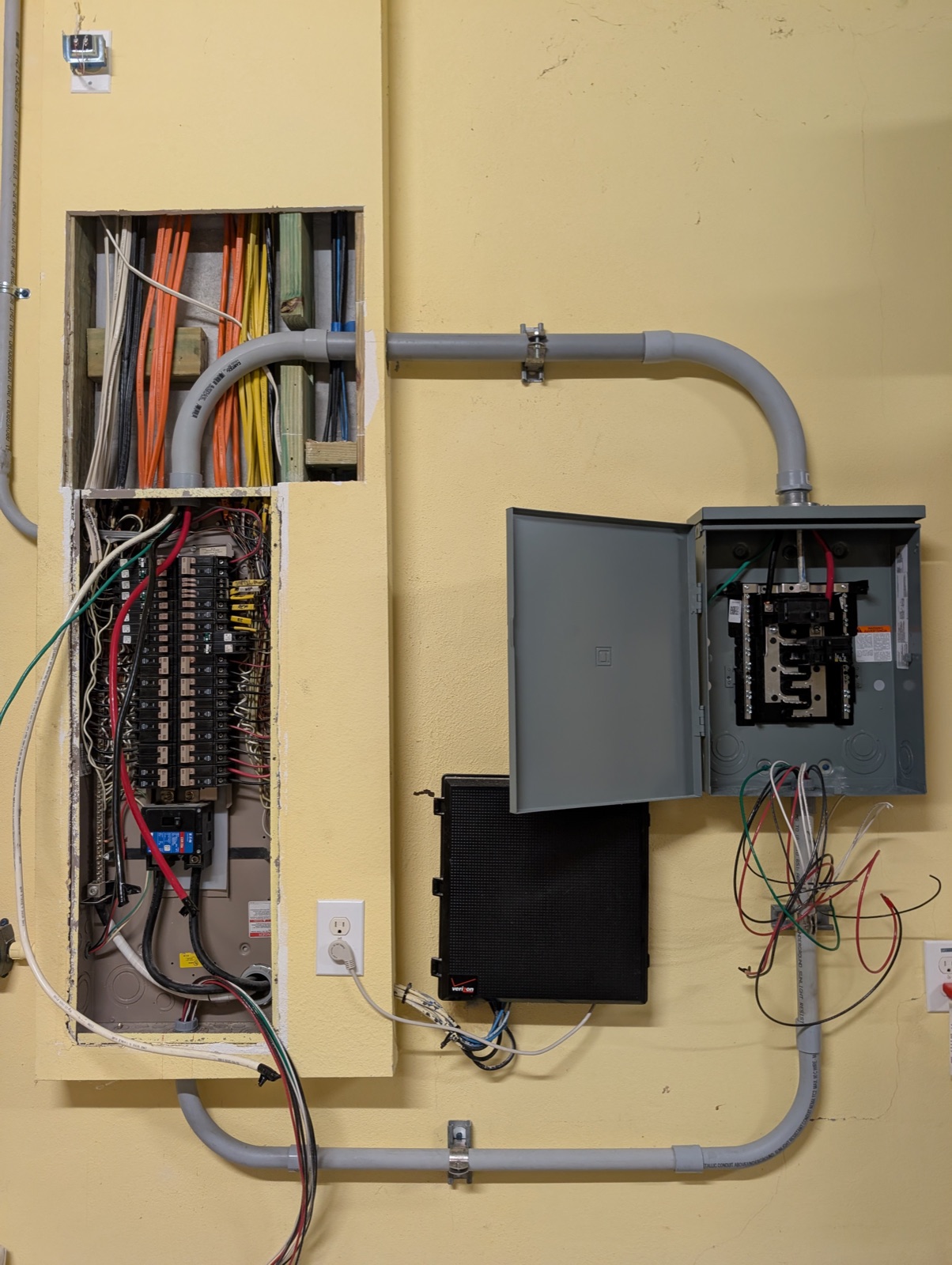
You can see the surface-mounted conduit running across the wall, the cut opening above the original panel for the feeder wires, and the new sub-panel with breakers being landed. None of the new wiring runs inside the drywall. Everything goes through visible EMT conduit. That makes the install cleaner and the inspection easier.
A closer look at the panel with the interlock plate at the top:
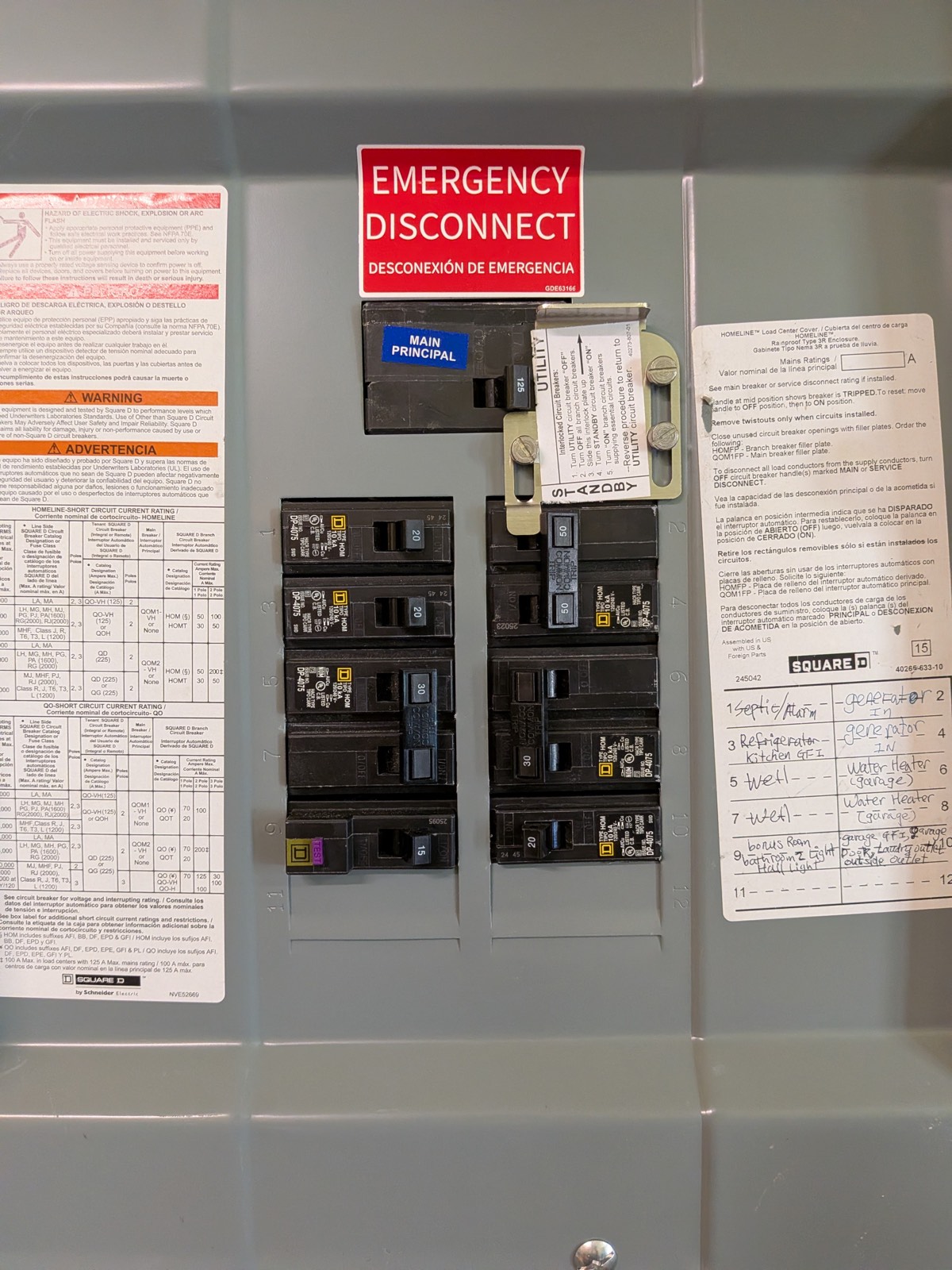
The interlock is the small yellow metal plate labeled "Utility" and "Standby" at the top. Slide it one way and the main breaker is exposed while the generator breaker is blocked. Slide it the other way and the opposite is true. There's no way to turn both on at the same time. The red "Emergency Disconnect" label is a National Electrical Code requirement for outdoor service equipment.
Outside the garage, on the concrete block wall:
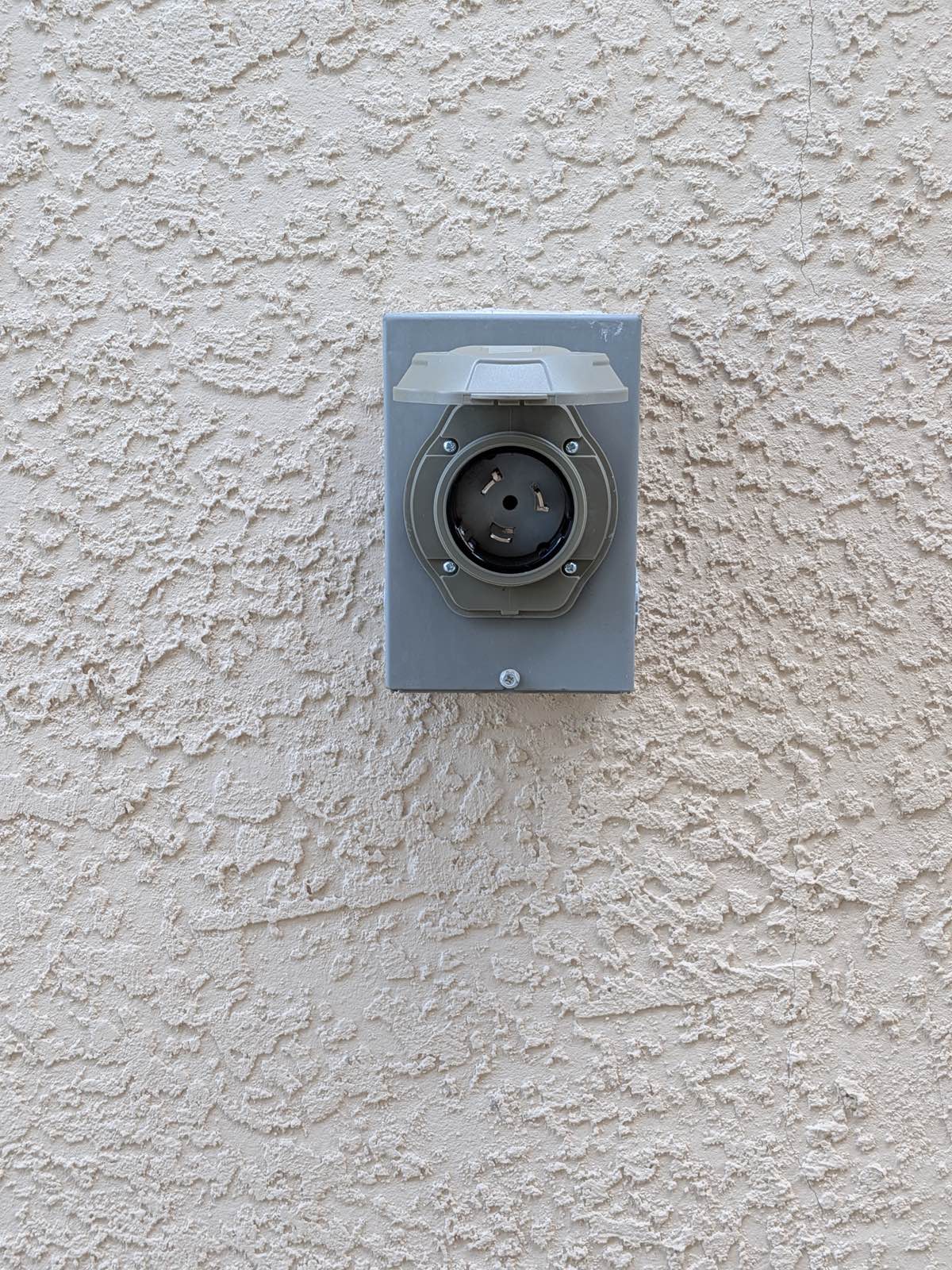
This is the 50-amp generator inlet. During an outage, you run a single heavy cord from the portable generator (which sits at least 20 feet from the house, per CPSC carbon monoxide guidance) and plug it into the inlet. The cord stays outside. No windows open, no cords running under doorways.
How much does a generator sub-panel cost to install?
Below is the actual estimate Jia generated through estimate4u.io for this project, on his own house, with his real address and project specs. Personal details are blurred. Everything else is exactly what the tool produced.
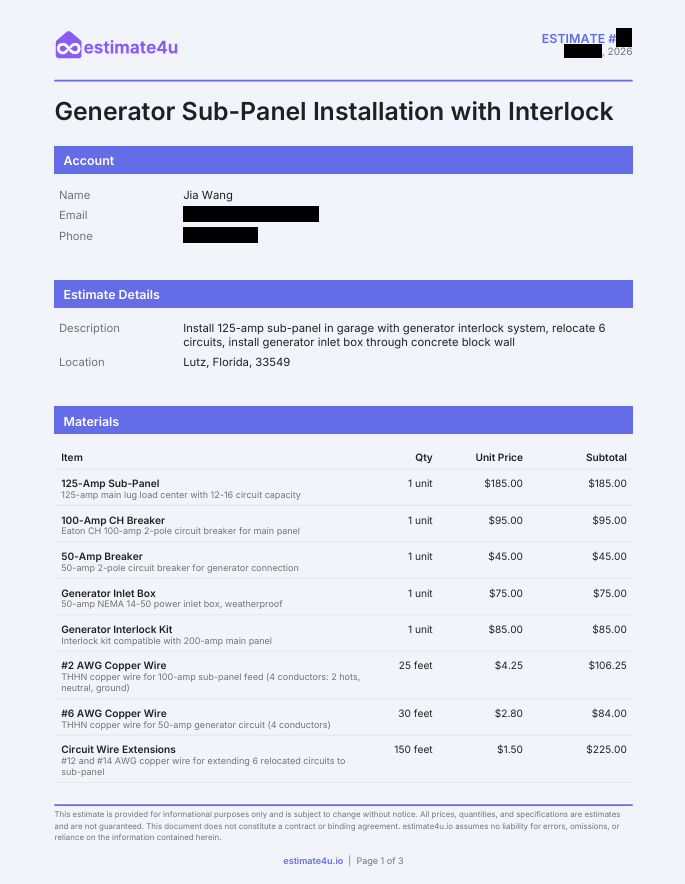
Click the estimate image above to view a full line-item breakdown of all end-to-end sub-panel costs.
Here is what the estimate breaks down to:
- Materials: $1,090.25. 125-amp sub-panel ($185), 100-amp CH breaker ($95), 50-amp generator breaker ($45), 50-amp NEMA 14-50 inlet box ($75), interlock kit ($85), 25 ft of #2 AWG feeder wire ($106.25), 30 ft of #6 AWG generator circuit wire ($84), 150 ft of circuit wire extensions ($225), EMT conduit and fittings ($125), and connection hardware ($65).
- Labor: $1,550.00. 16 hours of licensed electrician work at $75/hr ($1,200), core-drilling through the concrete block wall for the inlet conduit ($150), and a helper for wire pulling ($200).
- Permit and inspection: $375.00. Pasco County electrical permit ($275) and inspection ($100).
- Tax (7%): $184.82. Florida sales tax applied to materials and labor only; government fees are not taxed.
- Final total: $3,200.07. What hiring this project out to a licensed electrician would cost in Lutz, FL in 2026.
For context on the labor rate: the BLS reports the average hourly wage for electricians at $32.66 in May 2024. That's what the electrician personally takes home. Contractor billing rates are usually 2 to 2.5 times that, which covers insurance, tools, the truck, and the company's overhead. $75 per hour for licensed work in Florida is around the middle of the expected range.
The alternative is a whole-house standby generator. Installed, those run $5,000 to $15,000, usually around $11,000 for a similar set of circuits. The sub-panel route costs about one-fifth that and powers the same fridge, well, septic, and water heater. You have to start the generator and slide the interlock yourself when the power goes out. That takes about two minutes. For two minutes of work once or twice a year, the homeowner keeps roughly $8,500 in the bank.
The exact prompt to get this estimate for your own house
Here is what Jia typed into estimate4u.io to generate the document above. Copy it, swap in your own details, and you'll get a comparable estimate for your house in about two minutes:
"I have an existing 200 amp main electrical switch panel in the garage. Want to add a sub-panel for a portable generator. The sub-panel has capacity of 125 amp. Need to put a new 100 amp type CH circuit breaker on the main panel to connect the power supplier from main to the sub panel during normal situation when not using the generator. Also need to put a new 50 amp breaker for connecting to the generator inlet. The sub-panel will be in garage, side by side with the main panel, probably 4 ft away. Will move totally six current circuit breakers on the main panel to the sub-panel."
"Will put the generator inlet on the exterior garage wall, which means that I need to drill a hole through the garage concrete block wall. No transfer switch, use interlock only. Since we need to connect the 6 breakers after moving them to the sub-panel from the main to sub panel, so the total wire runs will be not just 10-15 ft to my thought. need the permit and inspection of course."
Vague prompts give wide ranges. Detailed prompts give a real number you can take to two or three electricians and compare against their quotes.
Questions to ask the electrician before signing
The estimate above came with a pre-signing checklist built in. Here are the key questions that matter most for a sub-panel and interlock job:
- Are you licensed in this state, and will you pull the permit in your name?
- Is the interlock kit a listed kit for my specific main panel brand and model? A Square D kit on a Square D panel. An Eaton kit on an Eaton panel. Third-party "universal" kits exist but they're a gray area for inspectors.
- Does my main panel have physical slots for the generator breaker and interlock? If the panel is already full, that's a separate cost. It needs to be in the quote before work starts.
- Does the generator inlet match my generator's output? A 50-amp inlet handles most portable generators up to 12,000 watts. Larger portables in the 13,000 to 14,000 watt range need a 60-amp inlet.
- Will you provide a generator connection diagram? A simple drawing of which circuits the sub-panel feeds, mounted inside the panel door. Useful for the next homeowner and for resale.
- Will all circuits be labeled, with the interlock steps clearly marked? NEC 702.7 actually requires this. Clear labels also mean anyone in the family can switch to generator power during an outage without calling you.
- What's the labor warranty? For electrical work at this scope, expect 1 to 2 years.
For more general guidance, see How to Tell If a Contractor's Estimate Is Too High and Five Hidden Costs of a Home Renovation.
Sizing the generator
Jia runs a Pulsar 10500W dual-fuel portable. Dual-fuel means it accepts gasoline or propane, which matters after a hurricane: gas stations run dry within a day, but propane tanks store fine for years.
The 10,500-watt label is the peak rating. Continuous output is closer to 8,000 watts. That's enough to run the well pump (1,500 watts starting load), the septic pump (1,000 watts), the water heater (4,500 watts), and the fridge (200 watts running, 1,200 starting) without much juggling.
A simple sizing approach:
- List the appliances you can't live without.
- Add up their running watts.
- Add the largest single starting load on top.
- Add 25% safety margin.
For a typical household essentials package, that usually lands between 7,000 and 10,000 watts.
What this comes down to
A backup generator sub-panel with an interlock kit is one of the cheapest hurricane-readiness projects worth doing. It costs about a fifth of a whole-house standby generator and powers the same essentials. The decisions that matter (interlock or transfer switch, which circuits to feed, how big the generator should be) aren't complicated once you see a real example laid out.
If you live in Florida, Texas, the Carolinas, Georgia, or anywhere along the Gulf or coast, and the start of the 2026 hurricane season just put this on your list, generate your own estimate at estimate4u.io. Use Jia's prompt above as a starting point. You'll get materials and labor separated, permit and inspection broken out, and a pre-signing checklist tailored to the work.
For the broader pre-season project list, see Home Improvement Projects to Finish Before Hurricane Season.
Sources
- U.S. Department of Energy, Hurricane Milton Situation Report #6 (Oct 15, 2024)
- Duke Energy Florida, Hurricane Milton restoration update for Pasco County
- National Electrical Code, Article 702 (Optional Standby Systems), industry reference
- U.S. Consumer Product Safety Commission, Portable Generator CO Fatalities Report (2022)
- U.S. Bureau of Labor Statistics, Electricians (May 2024 data)
- Pasco County, FL Building Construction Services, Permits and Forms
Want an independent line-item estimate?
Describe your project in plain words and get an AI-powered breakdown of labor and materials in minutes. Free for homeowners.
Get my estimate