
How Much Does a New Roof Cost in Florida in 2026? Real Numbers, the Insurance Discount, and What Quotes Hide
2026 Florida roof replacement cost by material and county, the wind mitigation insurance discount that pays the roof back, and the line items contractors leave off the quote.
It is June 15. Two weeks into hurricane season. If your roof is the same one that took everything Milton threw at it last fall, you are probably looking up at it now and wondering whether it will hold through another August.
A lot of Florida homeowners are in that spot. The next question is always the same: what does a new roof actually cost in 2026, and how do I tell a fair quote from a padded one?
The short version: most Florida homeowners pay $12,000 to $22,000 for an architectural shingle roof on a 2,000 square foot home. But that average hides a lot. The same house in Lutz, Orlando, and Miami can come back with three very different quotes, and the gap is not always the contractor being honest or greedy. It is the building code, the county permit fees, and a handful of line items that show up only after the old roof comes off.
Here is what the real numbers look like, what gets hidden, and the insurance discount that pays the whole thing back faster than most people realize.
Florida roof replacement cost by material in 2026
Numbers below are for a typical 2,000 square foot home, fully installed, based on 2026 published cost data.
Architectural asphalt shingles. The most common pick. $6 to $11 per square foot installed, or about $12,000 to $22,000 total. Handles 110 to 130 mph winds. Lasts 20 to 30 years.
Standing seam metal. $12 to $18 per square foot. $16,000 to $36,000 total. Higher upfront, but a 40 to 70 year lifespan and the strongest insurance discounts available.
Clay or concrete tile. $10 to $25 per square foot. $22,000 to $45,000+ total. Heavy, slow to install, but standard on a lot of South Florida homes for a reason. Lifespan 50+ years.
Three-tab shingles. Still legal, still the cheapest. We are not listing a price here because no Florida roofer worth hiring will recommend them in 2026. Wind resistance is around 70 mph. Not enough for a tropical storm, let alone a hurricane.
The bigger question, before material, is how long you plan to stay in the house. Shingles if it is under 10 years. Metal or tile if you are staying 20+. The long-term math almost always favors metal or tile, but the cash up front is real.
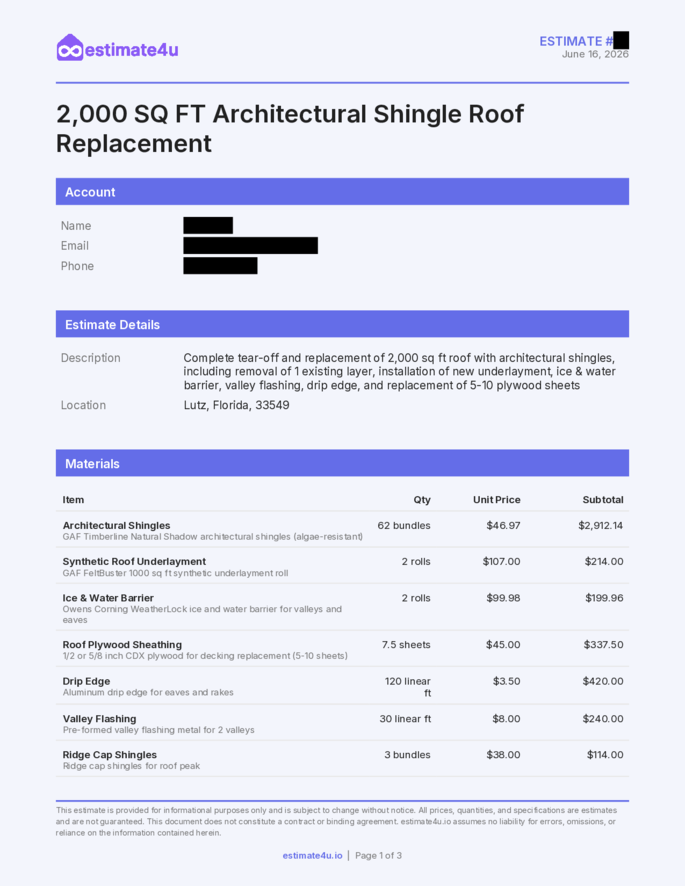
Here is a real estimate for a 2,000 sq ft architectural shingle roof in Lutz, FL: $16,834.48 total including materials, labor, permit, and inspection.
Why a Florida roof costs more than the same roof in Ohio
Three reasons your roof is more expensive here.
1. The High Velocity Hurricane Zone. If you live in Miami-Dade or Broward county, you are in the HVHZ. Contractors must use NOA-approved materials rated for extreme wind speeds, and projects face stricter inspections. These factors typically add 15 to 20 percent to the total cost compared to the state average.
2. Sealed roof deck. Florida code requires a sealed roof deck in the High Velocity Hurricane Zone and many other high-wind parts of the state. Roofers usually meet this with self-adhering (peel-and-stick) underlayment, but taped deck seams with a synthetic underlayment can also qualify. Either way, this is the layer that keeps water out of your house if shingles come off in a storm, and it costs more than a basic felt install.
3. Permit fees and inspections. Florida permits typically run $150 to $500 depending on jurisdiction. Pinellas County is on the higher end at $200 to $600. Small money on a $20,000 job, but skipping the permit can stop the work mid-project if caught, create problems with future insurance claims, and become an issue when you sell the house.
The flip side is that Florida roofers know hurricane work cold. The state employs more roofers than any other, with a mean wage around $47,000 per year. That means real competition. You can use it.
The 4 line items contractors love to leave off the quote
This is where most thin quotes fall apart. A clean estimate shows each of these as its own line. A weak one rolls them into "labor" or leaves them out and bills you later as a change order.
Decking replacement. Once the old shingles come off, the plywood underneath is exposed. Some of it is almost always rotted, especially on older homes with heavy tree cover. Budget $50 to $75 per sheet of plywood that needs replacing. Many roofs need 5 to 15 sheets. A fair quote shows the per-sheet price and the assumed count, then adjusts based on what is actually found.
Tear-off of multiple layers. Some older Florida roofs have two or three layers of shingles stacked on top of each other. This was allowed under earlier code but is no longer permitted on new installs. Extra tear-off labor typically runs $500 to $1,500.
Drip edge, flashing, and pipe boots. Small items, easy to skip on a quote, expensive to add as a change order. New flashing around chimneys, vents, and skylights is normal on a full replacement. If none of that is on the quote, ask.
Debris removal. A tear-off generates several tons of waste. Disposal typically runs $400 to $800. Sometimes folded into labor, sometimes its own line, sometimes missing entirely.
For more on how vague labor lines become surprise bills, see Five Hidden Costs of a Home Renovation.
The FORTIFIED upgrade that pays back faster than you think
If your roof is over 15 years old and you are replacing it anyway, the smarter question is whether to upgrade to the IBHS FORTIFIED standard.
FORTIFIED is a building standard with three tiers (Roof, Silver, Gold), each adding more protection. The base tier is just the roof. It adds a sealed roof deck (the same sealed deck Florida code already requires in HVHZ and many high-wind areas), enhanced edge sealing, and stronger fastening. The total cost premium runs $1,000 to $3,000 over a regular re-roof.
For that extra spend, you get two things. A roof that is far less likely to fail in a hurricane. And documentation your insurance company is required by Florida law to credit on your premium.
That second part is where the math gets interesting.
The Florida wind mitigation discount that pays the roof back
Most Florida homeowners do not know this, and it is the number that changes the entire calculation.
Florida Statute 627.0629 requires every residential insurer in the state to give discounts on the windstorm portion of your premium for any home with documented mitigation features. It is not optional for the insurer.
The features that earn credits: hip roof shape, hurricane straps or clips, sealed roof deck, secondary water barrier, and roof covering rated for high wind. Most come automatically with a code-compliant 2026 roof. The rest can be added during the replacement for a few hundred dollars more.
The discount itself: when all features are maximized, total credit on the windstorm portion of your policy can reach up to 88 percent. Even documenting one or two existing features can save $200 to $500+ per year.
To collect the discount, you need a wind mitigation inspection. The inspector fills out a state form called the OIR-B1-1802. The updated version of the form took effect April 1, 2026, the first major revision in over a decade. The inspection itself runs $100 to $150, and any licensed Florida inspector can do it.
The math is hard to beat. A $150 inspection that saves $500 to $900 a year pays back in three to four months. Over the 25-year life of the roof, the windstorm credit alone can return $12,000 to $22,000 in premium savings. That is the cost of the roof itself.
My Safe Florida Home grants up to $10,000
If you have heard about state grants for hurricane work, that is the My Safe Florida Home program (MSFH), run through the Florida Department of Financial Services.
The 2025-2026 cycle was funded at $352 million. The state pays $2 for every $1 the homeowner spends, up to a maximum state contribution of $10,000. Three of the five covered improvement categories are roofing work: roof-to-wall reinforcement, roof-deck attachment strengthening, and secondary water barrier installation.
Two important catches.
First, do not start any work before grant approval. Starting early automatically disqualifies your application.
Second, the Florida Legislature has not approved new MSFH funding for the 2026-2027 fiscal year as of this writing. If you want to use the grant on your current project, check the program status at myfloridacfo.com before you sign a contract.
Even if the grant funds run out, the free wind mitigation inspection has standalone value. The OIR-B1-1802 form is what your insurance company already uses to apply premium discounts. Worth doing either way.
What to ask before signing a Florida roof quote
Five questions. The answers tell you more than the total price does.
1. Is the permit a separate line on this quote? Should be. If it is folded into labor or missing, ask exactly what the permit fee will be and who pays it.
2. What is your per-sheet price for replacement decking? A good roofer will say something like "$55 per sheet, assuming 10 sheets, billed at actual count." A bad one will say "we will see when we get up there."
3. How will you meet the sealed roof deck requirement? Most Florida roofers use self-adhering (peel-and-stick) underlayment. Taped seams with a synthetic underlayment can also qualify. Either answer is fine. "15-pound felt" alone is not.
4. Will this roof qualify me for the maximum wind mitigation discount? A roofer who has done this work in Florida for more than five years should be able to walk you through which credits apply to your house.
5. Are you licensed and insured in this county, and can I see proof? Florida licenses are public record. Verify on the DBPR portal before you sign anything.
For a deeper checklist of red flags in any contractor quote, see How to Tell If a Contractor's Estimate Is Too High. For a real Florida project breakdown with permit and inspection costs, see How Much Does a Generator Sub-Panel Cost? A Real Florida Install.
Before you take the first quote
A roof is the biggest single repair most Florida homeowners ever pay for. The gap between a fair quote and a padded one can easily run $5,000 to $8,000, and the only way to spot it is to have your own number to compare against.
Run your project through estimate4u.io for a free line-item estimate. Materials and labor broken out by category, based on current US market data. Every estimate also comes with a Pre-Signing Checklist of questions specific to your project that you can take straight to the contractor conversation. It takes about two minutes.
Walking into the next quote review with your own breakdown in hand changes the dynamic of the call entirely. You are no longer comparing a single number to a feeling. You are comparing line items to line items, and that is the conversation where hidden costs come out.
Sources
Data in this article is from 2025-2026 published reports:
- Florida Statutes Title XXXVII § 627.0629
- IBHS, FORTIFIED Home Program
- Coastal Roofing of South Florida, 2026 Pricing Guide
- HiPoint, Florida Roof Replacement Cost 2026
- Pinellas Roof, Florida Roof Replacement Cost 2026
- Armor Pro Windows, My Safe Florida Home 2026 Guide
- Pegasus Lends, Florida Wind Mitigation Savings 2026
- Bureau of Labor Statistics, Roofers Occupational Outlook
Want an independent line-item estimate?
Describe your project in plain words and get an AI-powered breakdown of labor and materials in minutes. Free for homeowners.
Get my estimate